


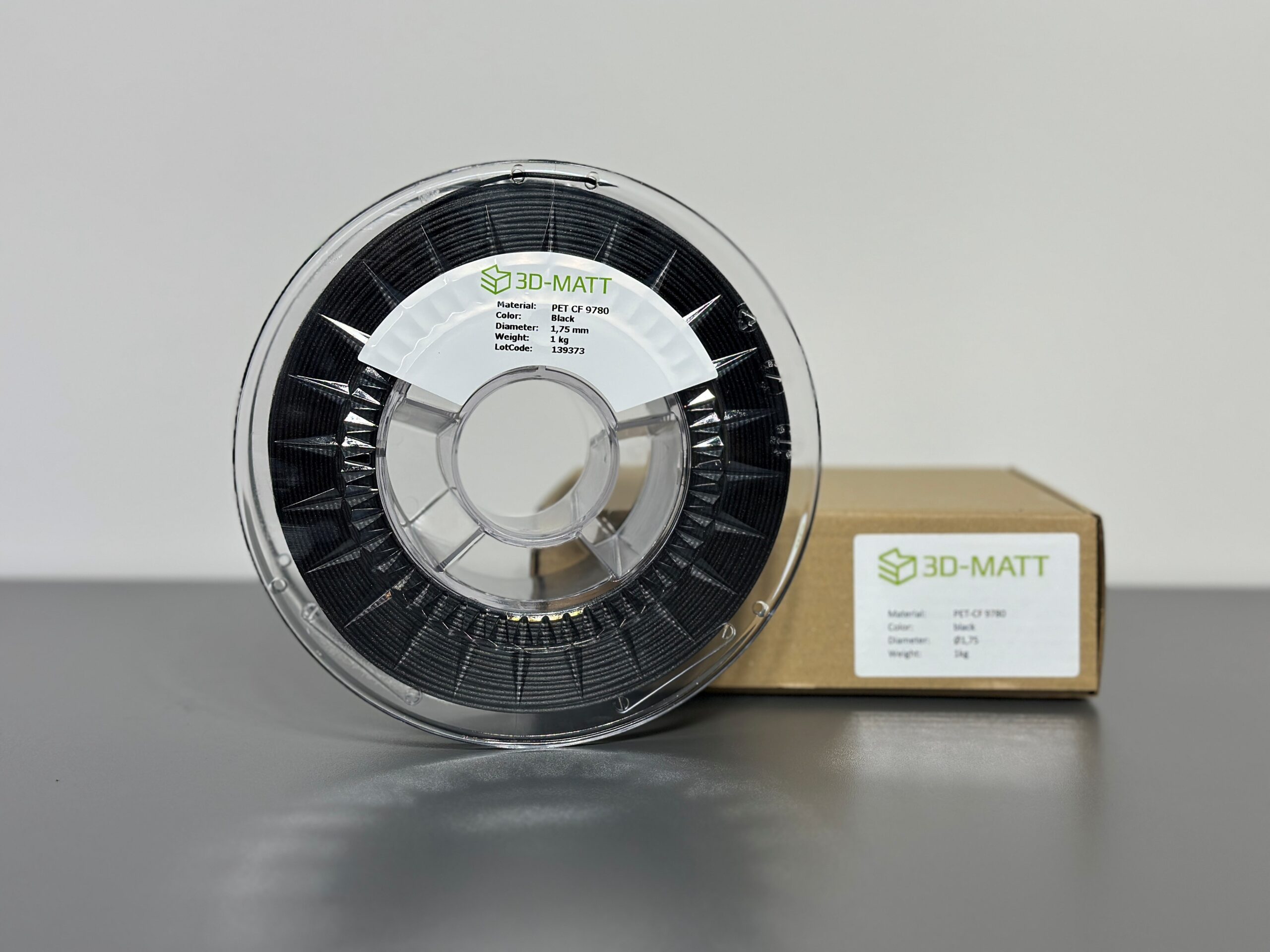
PET-CF 9780 BK – 1kg Filament
1kg - Ø1.75
| Quantity | Discount | Price per piece |
| 1 - 4 | - | 90,00 € |
| 5 - 10 | 3% | 87,30 € |
| 11 - 20 | 5% | 85,50 € |
SKU: PET-CF
Description
PET-CF 9780 BK is a high-performance, carbon-fibre-reinforced PET filament (polyethylene terephthalate) developed specifically for technical applications with increased mechanical and thermal requirements. Thanks to a precisely balanced carbon fibre content, the material offers exceptional stiffness, high tensile strength and excellent dimensional stability, while remaining very easy to process on common FDM/FFF printing systems.
With its heat resistance of up to approx. 120 °C, low water absorption and excellent layer adhesion, PET-CF 9780 BK is ideal for functional parts, jigs and fixtures, housings and structurally loaded components. The carbon fibre reinforcement significantly reduces warping and enables the production of distortion-free parts with high dimensional accuracy, even on larger print areas.
Thanks to its electrically non-conductive formulation, the material can also be used for applications in electronics and mechatronics. The matte, technical surface also ensures a high-quality appearance and low reflections, ideal for precise functional parts with a professional look.
Technical features at a glance:
- Carbon-fibre-reinforced PET for industrial applications
- High stiffness and strength
- Heat deflection temperature up to approx. 120 °C
- Low water absorption
- Very good layer and bed adhesion
- Significantly reduced warping thanks to CF content
- Electrically non-conductive
- Compatible with many FDM/FFF systems
Typical applications:
- Functional prototypes and end-use parts
- Jigs, brackets and workpiece holders
- Housing parts with technical requirements
- Structural components in mechanical engineering
- Parts for automotive, electronics and robotics
Note: To achieve full thermal and mechanical performance, the printed part must be annealed. Only annealing allows the material to fully crystallise and reach its final properties.
The material must be dried before printing (24 to 48 hours at 90 to 95 °C).
We recommend processing the material from a dry box.
Related products
-
PPS-CF BAW Support – 1kg Filament
45,00 €
plus VATplus shippingAdd to request cart -
PLA white – 1kg Filament
25,00 €
plus VATplus shippingAdd to request cart -
PAHT 9936 BK – 1kg Filament
90,00 €
plus VATplus shippingAdd to request cart