


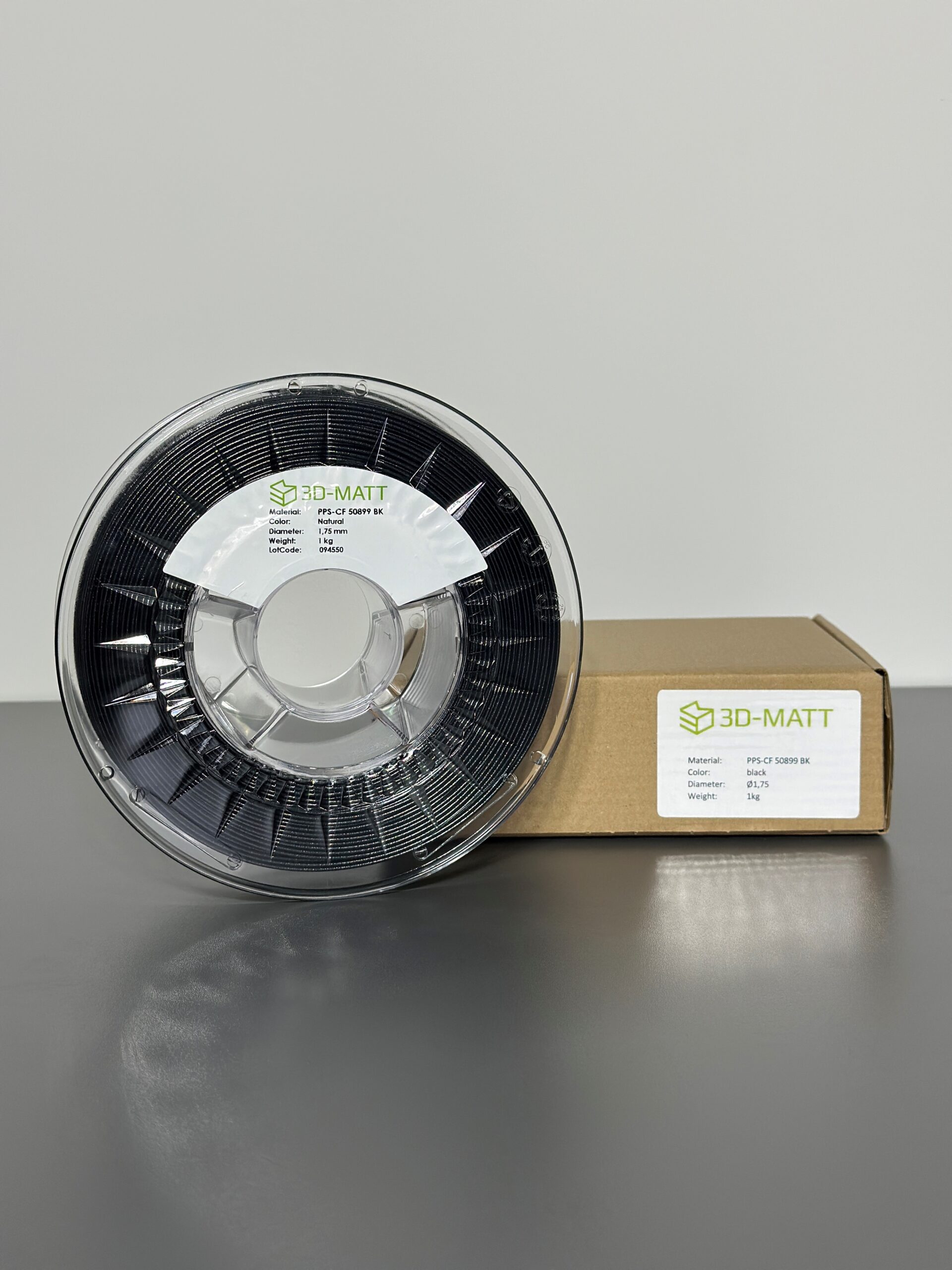
PPS-CF 50899 BK – 1kg Filament
1kg - Ø1.75
| Quantity | Discount | Price per piece |
| 1 - 4 | - | 130,00 € |
| 5 - 10 | 3% | 126,10 € |
| 11 - 20 | 5% | 123,50 € |
SKU: PPS-50
Description
PPS-CF 50899 is a carbon-fibre-reinforced high-performance polyphenylene sulphide (PPS) for industrial 3D printing. The material meets the highest requirements for thermal, mechanical and chemical resistance and is ideal for producing functional parts under extreme operating conditions. A heated build chamber is not required!
With a heat deflection temperature of over 250 °C and excellent chemical resistance to aggressive media such as acids, alkalis, fuels and solvents, PPS-CF 50899 is the first choice for applications in demanding industrial environments. Short-term temperature peaks of over 300 °C are tolerated without structural impairment. Its inherent flame retardancy according to UL94 V0 and high dimensional stability allow reliable use in safety-critical areas. In addition, the carbon-fibre-reinforced matrix offers outstanding stiffness comparable to metal-like properties.
PPS-CF 50899 is an advanced in-house formulation that offers significantly higher process reliability during printing compared to standard PPS-CF materials on the market. Despite its high carbon fibre content, the material remains electrically non-conductive, a decisive advantage for applications in electronics or sensitive assemblies.
Technical features at a glance:
- Heat deflection temperature > 250 °C
- Short-term temperature resistance above 300 °C
- Excellent chemical resistance (acids, alkalis, fuels, solvents)
- UL94 V0 certified, inherently flame retardant
- High stiffness thanks to carbon fibre reinforcement
- Electrically non-conductive
- Dimensional stability and moisture resistance
- Improved in-house development with above-average process reliability
- Printable on open systems (unheated build chambers)
Typical applications:
- Components for aerospace engineering
- Electronic assemblies and housings
- Tool and mould making
- Motorsport technology
- Automotive industry
- Rail vehicle technology
Note: To achieve full thermal and mechanical performance, the printed part must be annealed. Only annealing allows the PPS to fully crystallise and reach its final properties.
The material must be dried before printing (24 to 48 hours at 90 to 95 °C).
We recommend processing the material from a dry box.
Related products
-
ABS white – 1kg Filament
30,00 €
plus VATplus shippingAdd to request cart -
PET-G white – 1kg Filament
30,00 €
plus VATplus shippingAdd to request cart -
PPS-CF BAW Support – 1kg Filament
45,00 €
plus VATplus shippingAdd to request cart